
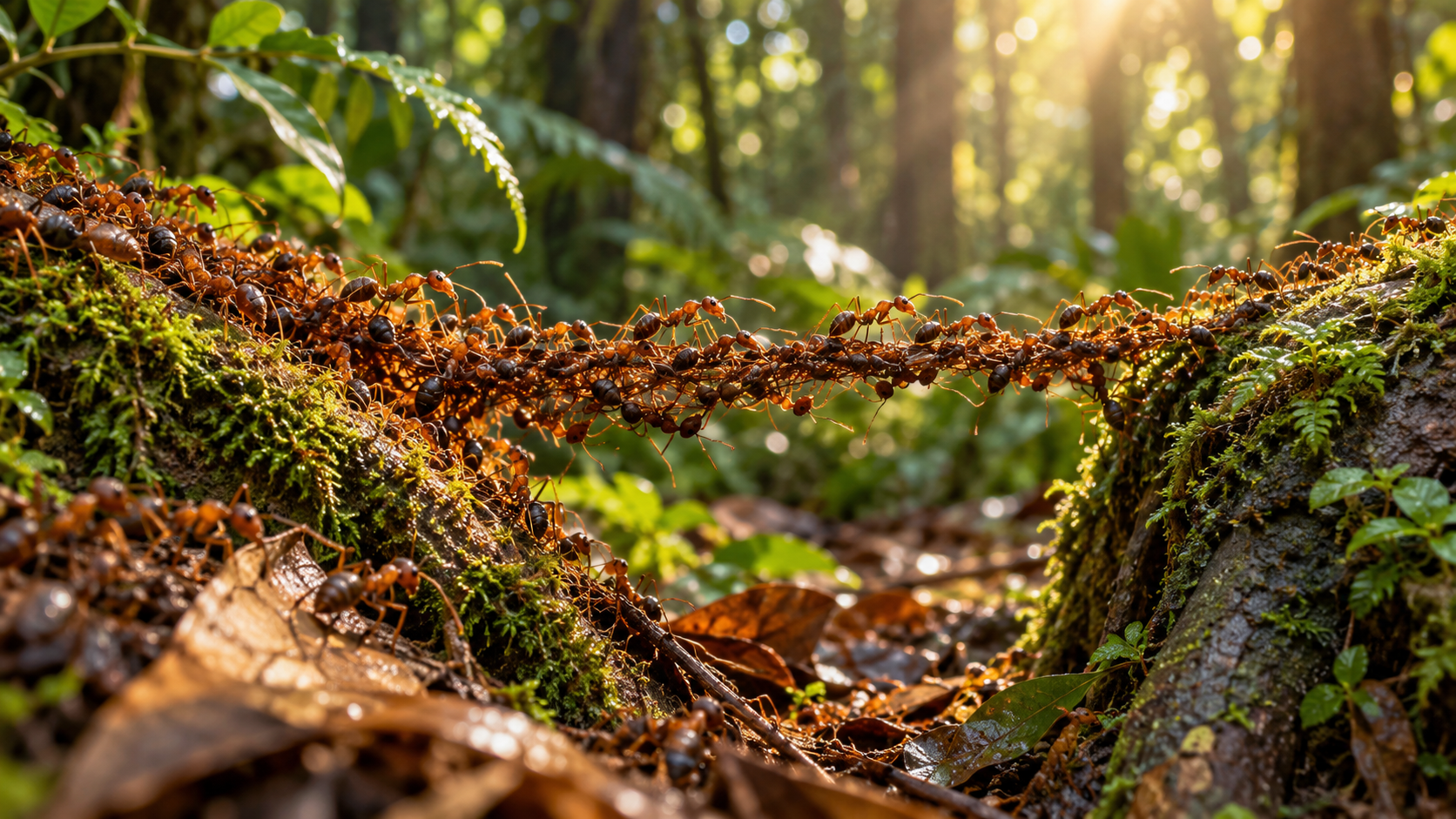
Ants can build a bridge without a single ant knowing the whole plan.
When Eciton army ants encounter a gap in their trail, some link their bodies together while others walk across them. Each ant responds to its immediate surroundings and its connections with other ants. Together, they build a path that keeps the colony moving.
Local decisions become collective work.
At Eciton Robotics, we’re building communication frameworks through hardware and software to bring that principle to robot fleets. Robots will use local information and peer communication to coordinate, without depending on a central controller for every decision.
The lesson in a living bridge
Researchers studying Eciton ants found that their bridges adapt through local interactions. The colony balances the benefit of a shorter path against the workers needed to maintain it. Each ant responds to nearby connections and passing traffic; those interactions shape the bridge as a whole. The field study shows how a group can adapt through individual behavior.
The lesson for robotics is coordination through local rules. Each robot contributes using what it observes and what it learns from its peers. A discovery becomes useful when it reaches a teammate that can act on it.
Local information.
Collective work.
A scout might find an area that needs a different sensor. A nearby robot can take that task. Another can carry the report toward the base. Each contributes to the same mission through a different local action.
The scaling problem
Adding robots adds observations, task choices, and messages. The challenge is deciding what needs to travel, who needs it, and when it still matters.
With all-to-all communication, every robot has a direct connection to every other robot. A fleet of n robots has n(n − 1) / 2 possible links. If each robot sends every update to every peer, message deliveries grow with those pairs.
A central hub can use fewer direct connections, but its processing and forwarding load grows with the information passing through it. The architecture matters as much as the number of robots.
Try the comparison below. Increase the fleet, change the update rate, or adjust how many peers each robot talks to.
More robots. How much more communication?
Change the fleet size to compare everyone talking to everyone with a connected local neighborhood.
All-to-all
Every robot talks to every other robot
- Communication links
- 4,950
- Packet deliveries / second
- 9,900
- Payload traffic
- 1.27 MB/s
Local neighbors
Up to 6 peers per robot
- Communication links
- 300
- Packet deliveries / second
- 600
- Payload traffic
- 76.8 kB/s
Network drawings show up to 24 robots. The counts use the full fleet.
How the comparison works
Links are two-way connections. All-to-all uses n(n − 1) / 2 links; the local model is a connected ring with up to k neighbors and n × min(k, n − 1) / 2 links. Each robot sends one packet per update to each neighbor. Traffic counts payload bytes across all those deliveries.
This is an illustrative unicast model, not a measured fleet result. Headers, retries and relay traffic add cost; radio broadcast can change delivery costs. A central hub can use n robot-to-hub links, with its load determined by the updates it receives and forwards.
The design question: which information actually needs to travel beyond a robot’s neighborhood?
Our approach keeps routine decisions local and moves information where it can change what the team does. A robot can share a finding with nearby peers, forward a useful summary, or relay a report toward its destination.
The goal is to grow the fleet without making every robot keep up with the entire fleet.
That means designing for bounded local knowledge, relevant recipients, and predictable communication costs. We’re building the framework around those constraints, tracking delivery, delay, resource use, and completed work together.
Hardware and software, built together
The ECITON-R Node will connect supported robots to the coordination framework through a robot adapter. We’re designing the Node around local decisions, peer communication, and the interfaces needed to work with existing robot platforms.
The host robot keeps responsibility for navigation, motor control, and safety. The Node exchanges observations and high-level task requests with it, linking the robot’s capabilities to the rest of the team.
On each robot. Across the fleet.
Host robot
Navigation · motors · safety
Observations inHigh-level task requests out
ECITON-R Node
Local decisions
Communication · coordination
Nearby peers
Share findings
Divide work · relay updates
On the software side, we’re developing the runtime that connects observations → decisions → communication → action. Robots will choose work using their local knowledge, update that knowledge when messages arrive, and share what their peers need.
Temporary coordinators can help combine information or organize nearby work. Those roles are designed to be replaceable, so coordination can continue as robots join, leave, or lose a connection.
Dispatch brings the fleet into view: mission goals, team activity, messages, and a record of what happened. We’re connecting the simulator and physical reporting path to that operator view.
The Node’s PCB design brings the communication hardware and host interfaces together. Development-board integration and physical testing are the next steps in bringing that design into the fleet.
Local intelligence, shared purpose
Learned communication behavior is in development. Compact models running on each robot will help decide when information is worth sharing, which peers need it, and when an update adds little value.
We’re developing that intelligence alongside a deterministic coordination runtime. The model helps choose a useful action; the protocol handles message validity, freshness, duplicate handling, and resource budgets.
The question guiding that work is practical: does a better local decision help the team complete its mission?
From one message to a coordinated team
Swarm Lab is where we develop and inspect the decision loop. In our recent direct-message milestone, one simulated robot shares task information that changes another robot’s next goal.
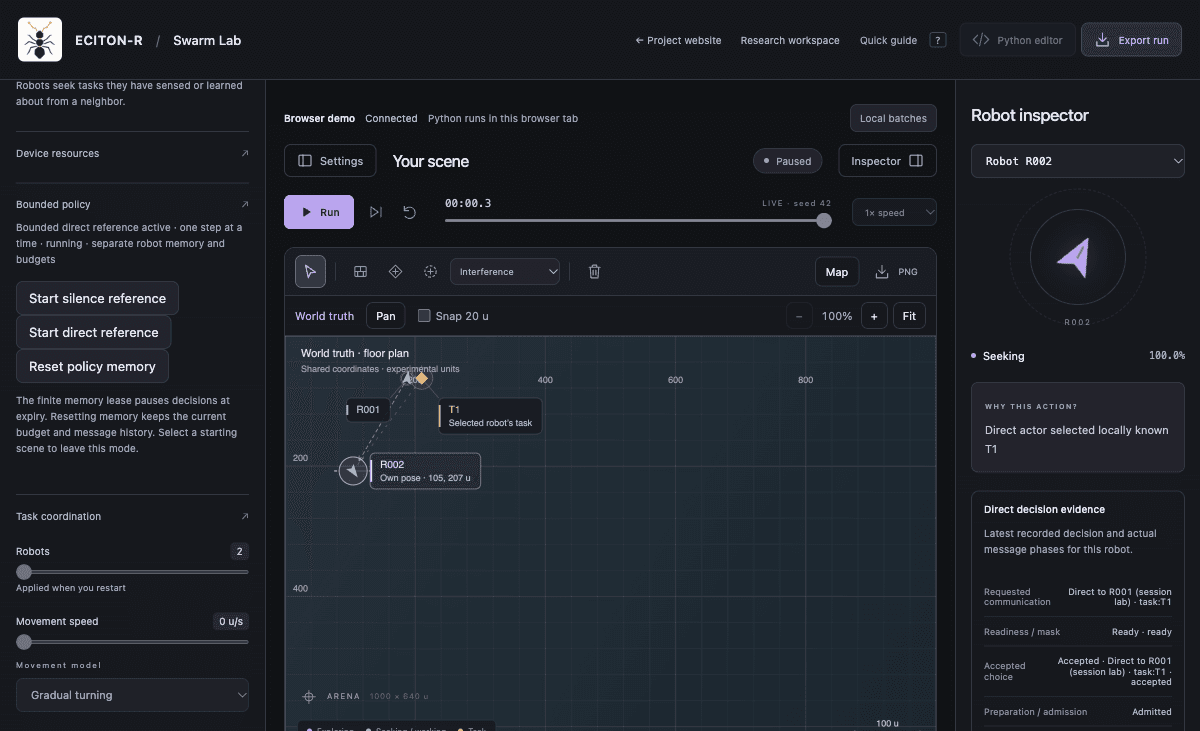 Swarm Lab showing a simulated robot’s local task knowledge after receiving a message from a peer.
We can follow that interaction from the sender’s choice through delivery to the receiver’s updated knowledge. It gives us a visible foundation for building more complex cooperation and testing how the system behaves as the team grows.
We’re now connecting those foundations across live simulation, Dispatch, and a physical sensing-and-relay demonstration. The next stage brings local decisions, radio communication, and operator visibility into a shared scenario.
Ants turn local interactions into something the colony can accomplish together. We’re building the communication layer that will help robots do the same.
Stay updated.
Follow the work as we connect the simulator, hardware and real robot teams.
Follow Anish on LinkedIn